Rescuers of Jews
Požėla Vladas
Miriam Javnaitė-Voronova
Gerb. bičiuliai, brangūs Lietuvos žmonės!
Jau beveik pusė amžiaus prabėgo nuo anų šiurpių dienų, kai virš niekuo nekaltos žydų tautos buvo pakibęs baisus hitlerinio fašizmo kalavijas, kuris neišskirdamas nei senelių, nei vaikų, nei motinų žudė mano tautiečius getuose, koncentracijos stovyklose, kalėjimuose. Kulkų pakirsti griuvome į duobes, tapusias brolių kapais, kuriuos, deja, šiandien ne visus ir besuskaičiuosi.
Ir už ką mes istorijai buvome taip nusikaltę? Gal už tai, kad dažniausiai esame tamsiaplaukiai ir juodaakiai? O gal buvome kalti, kad buvome mąstytojai, amatininkai, prekybininkai, gydytojai ir niekam nekliudydami ramiai ir taikiai dirbome tarp įvairių tautybių žmonių? Ne, ir dar kartą ne! Mes niekuo nebuvome ir iki šiol neesame tiek kalti, kad mūsų atžvilgiu buvo vykdomas toks baisus genocidas. Tai Hitlerio šizofreninė ideologija, teigusi jog visos rasės, išskyrus germanų, o ypač žydų, turi būti nušluotos nuo žemės paviršiaus.
Antrojo pasaulinio karo pragare žuvo 94% žydų tautos. Būtų žuvę žymiai daugiau, jeigu nebūtų atsiradę tokių kilnių ir taurių lietuvių, kurie rizikuodami savo gyvybe ir laisve, kiek galėdami mus gelbėjo pačių žmogžudžių panosėje.
Keletą žodžių noriu tarti apie savo gelbėjimosi Kryžiaus kelią.
Aš viena iš nedaugelio išlikusių gyvų žydų, nes mes visi buvome hitlerininkų pasmerkti mirti. Uždaryti gete, koncentracijos stovyklose, kalėjimuose, alkani, pažeminti ir trypiami kaip niekingiausi šios žemės gyviai, mes neturėjome teisės net džiaugtis saule, nors niekam ir niekada jos neužstojome. Dieną naktį mes privalėjome dirbti Šiaulių aerodrome, Pavenčių cukraus fabrike, Gaudučių durpyne, Daugėlių plytinėje, kelių ruože ir t.t. Už tai gaudavome sočiai mušti, o valgyti beveik nieko. Tie šiurpūs vaizdai, tie devyni Dantės pragaro ratai, kuriuos mes praėjome, dar ir šiandien neišnyko iš mūsų atminties.
Savo kančių kelyje aš sutikau daug taurių lietuvių, kurie mane slėpė, aprengė, maitino ir palaikė moraliai, rizikuodami savo ir savo šeimų gyvybe. Norėčiau, kad liktų įamžintos jų visų, taip man brangios pavardės ir vardai.
Tarp minėtų žmonių yra:
Šaukėnų kanauninkas a.a. Jonas Staševičius, tiek jėgų ir sveikatos paaukojęs mus gelbėdamas;
Kužių klebonas (tuomet Šiaulių kalėjimo kapelionas) Požėla Vladas, kuris padėjo man ir mano draugei Malinker Zeldai pabėgti iš kalėjimo, kuriame mes sėdėjome pasmerktos mirti;
Petrašiūnas, kepėjas, kuris sėdėjo kalėjime, todėl, kad į getą įvežė per daug duonos. Jis, pagal kapeliono prašymą, ir išsaugojo Zeldą;
Minkevičių šeima – Kotryna, Sergejus, a.a. Jokūbas. Jie gyveno Pavenčių cukraus fabriko teritorijoje ir paruošė man ir mano draugei Kloraitei Liubai pabėgimą. Kotryna išgelbėjo Goldbergaitę Goldą ir ją augino;
Prie pabėgimo plano įvykdymo prisidėjo Kuršėnų gyventojas Montvila, nežinau kur jis dabar;
Račkauskų šeima iš Pavainiškės kaimo, kurie mane slapstė ilgą laiką, kiek galėjo;
Ermanienė, dabar gyvenanti Kuršėnuose;
Porvaneckaitė Janina (Budzinskienė), dabar gyvenanti Šiauliuose, ji buvo mano klasės draugė Kelmėje;
Jocų šeima, gyvenantieji Šiauliuose. Jie slėpė ir užaugino inžinieriaus Krono dukrytę Rūtą;
Sutkevičiaus šeima, dabar gyvena Vilniuje, slėpė ir augino Navickio dukrelę Gražiną;
Grigalaitienė iš Daugėlių, kuri slėpė ir užaugino Funkaitę (ji dabar kaip tik atvažiavusi iš Izraelio į svečius pas savo mamytę Grigalaitienę).
Negaliu nesijaudindama kalbėti apie Venclauskų šeimą, kuri tiek daug padarė, kad išgelbėtų kuo daugiau mūsų tautiečių. Be to jie slėpė ir užaugino mergytę Chaną Blank, gyvenančią dabar Izraelyje.
Baigdama noriu pasakyti didelį ačiū Lietuvos sūnums ir dukroms, kurie savo krūtine uždengė mūsų gyvybę.
Esu laiminga sulaukusi Lietuvos atgimimo, kurio dėka ir nedidelė žydų tauta gali atgimti. Linkiu, kad atgimimas augtų ir stiprėtų draugystėje su žydų tauta.
Testimonies of the saved ones
Fania Giar-Meškauskienė (formerly known as Aleksandravičienė)
I, Fania Giar-Meškauskienė, formerly known as Aleksandravičienė, testify as to the humane behaviour of father Vladas Požėla during the fascist occupation. I was put in the Šiauliai prison in 1943 because I was Jewish and my neighbours notified the authorities of this fact. At the time Vladas Požėla used to hold Mass for prisoners there. He risked his life and freedom by gathering donations on a daily basis and bringing food for the collective pot. There are no words that can describe the extent of his help to the prisoners. He helped me by getting identification papers before I got arrested and in every other way too.
He created the conditions for my husband, L. Aleksandravičius, who did not renounce me and went to prison together. Father Požėla organised an orchestra and brought a cello for my husband, so he could come to see me every day, when he went to the women’s section of the prison to play music.
Požėla helped everyone without exception. There was no distinction in his mind between different ethnicities and religions, he helped and took care of every prisoner. /.../
Israel
Miriam Javnaitė-Voronova
/.../ I’ve met many noble Lithuanians in the time of my suffering who hid me even though by doing so they were risking their own lives and the lives of their loved ones. These people clothed us, fed us and gave heart to us. I gave all of their names, all of those people who are so dear to me, to the Jewish Culture Society.
Among the ones I mentioned (the saviours), is Vladas Požėla (Kužiai), who helped me, Malinkir (Zaidel) Zelda and Vinikaitė (from Kaunas) escape from the Šiauliai prison, where he served as chaplain at the time. We were facing death there. I know that many others were also helped to survive by this noble man.
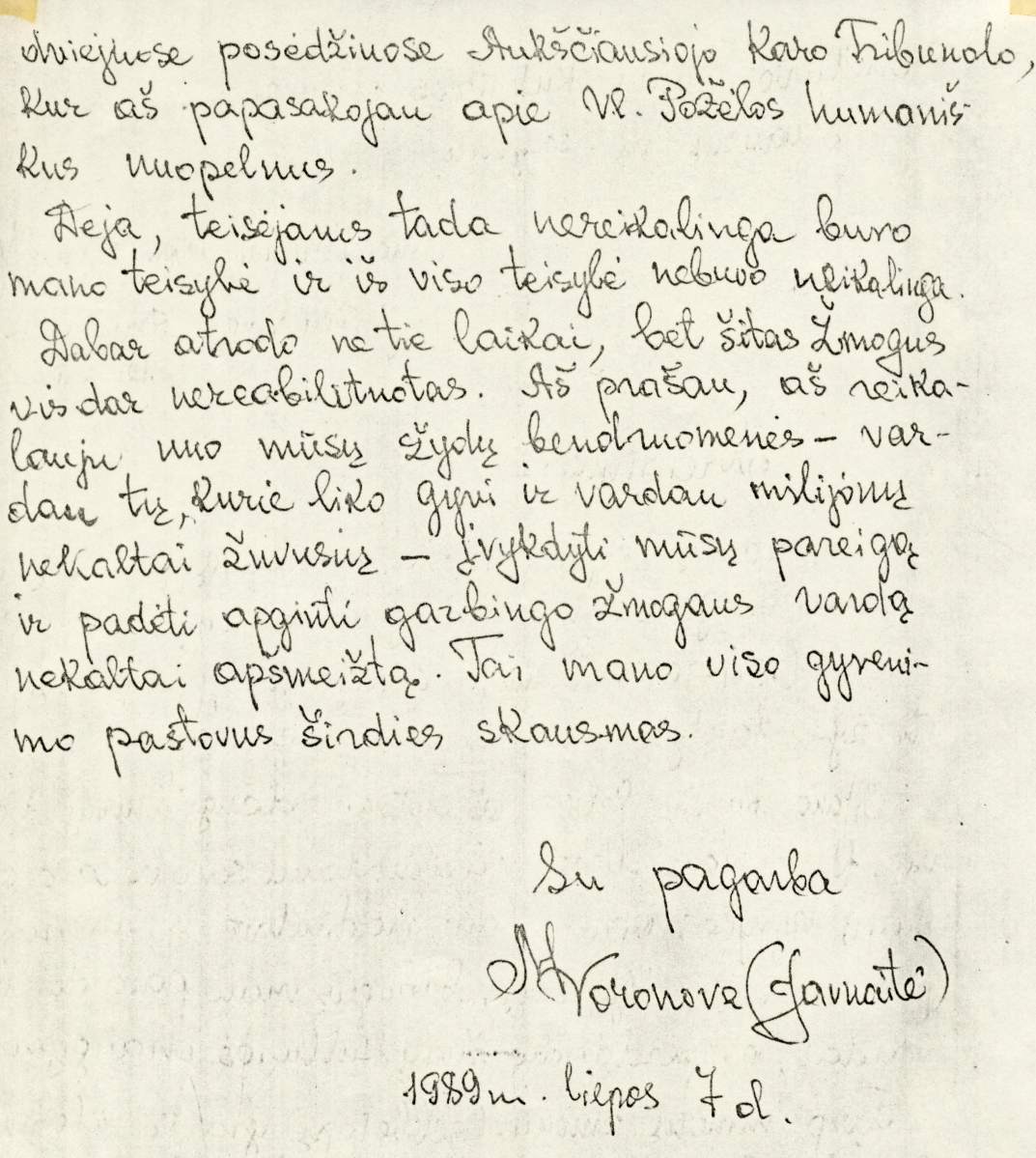
I attended two meetings at the Supreme Court-Martial in 1947 as a witness, where I told of the humane merits of Vladas Požėla.
Alas, the judges did not need my truth, or any truth, for that matter.
It seems that the times have changed, but this man still has not been rehabilitated (In 1946 V. Požėla was exiled by the Soviet government. Came back from exile in 1956). I ask, I demand in the name of the whole Jewish community – in the name of those, who stayed alive, and in the name of millions who died an innocent death – to fulfil our duty and help defend the good name of an honest Man, who has been falsely slandered. This is the perpetual heartache of my life.
An appeal, addressed to the Šiauliai department of the Jewish Culture Society, Šiauliai, 7 July 1989
Benjaminas Fuksis
/.../ 27 years ago we were locked away in the Šiauliai penitentiary. We were separated from other people and the world. They fed us worse than dogs. There were no news, no beam of truth made it’s way into the cells. /.../
But there are always people, who try to help in spite of everything, even the fear of death. They bring the news and letters from the loved ones to prison cells. /.../ They would feed those who were famished. They helped in any way they could, disregarding the nationality or political views of the prisoners. One of the people who helped prisoners the most, was the chaplain of the Šiauliai penitentiary, father Vladas Požėla. He travelled all around Lithuania in search of food and clothing, so he could help save the lives of those who were suffering. He was a man dedicated to other men. Požėla was a servant of the church and provided news from the front, fed the weaker prisoners, helped them morally.
There were 24 condemned political prisoners sitting in the death chamber at the time. Požėla secretly gave me a metal saw, so I could cut through the bars on the window and flee the cell. /.../
Požėla was a great, international person. People of all nations were equal in his eyes. He helped me, even though he knew that I was a Jew. I searched for Vladas Požėla for 26 years, I wanted to meet him and thank him for saving my life, and for my unexpected freedom to live and enjoy the world. Only because of him did I and many others survive.
Finally, we were reunited. This year I found out, that the priest lives in Skirsnemunė, Jurbarkas District. I was very happy that I would be able to see him and bow before him. Our meeting was very moving, tears of joy rolled down our faces. We had much to tell each other. /.../
An article by Benjaminas Fuksis, addressed to the editorial office of “Šviesa”, Kelmė
Fania Giar-Meškauskienė (formerly known as Aleksandravičienė)
I, Fania Giar-Meškauskienė, formerly known as Aleksandravičienė, testify as to the humane behaviour of father Vladas Požėla during the fascist occupation. I was put in the Šiauliai prison in 1943 because I was Jewish and my neighbours notified the authorities of this fact. At the time Vladas Požėla used to hold Mass for prisoners there. He risked his life and freedom by gathering donations on a daily basis and bringing food for the collective pot. There are no words that can describe the extent of his help to the prisoners. He helped me by getting identification papers before I got arrested and in every other way too.
He created the conditions for my husband, L. Aleksandravičius, who did not renounce me and went to prison together. Father Požėla organised an orchestra and brought a cello for my husband, so he could come to see me every day, when he went to the women’s section of the prison to play music.
Požėla helped everyone without exception. There was no distinction in his mind between different ethnicities and religions, he helped and took care of every prisoner. /.../
Israel
Miriam Javnaitė-Voronova
/.../ I’ve met many noble Lithuanians in the time of my suffering who hid me even though by doing so they were risking their own lives and the lives of their loved ones. These people clothed us, fed us and gave heart to us. I gave all of their names, all of those people who are so dear to me, to the Jewish Culture Society.
Among the ones I mentioned (the saviours), is Vladas Požėla (Kužiai), who helped me, Malinkir (Zaidel) Zelda and Vinikaitė (from Kaunas) escape from the Šiauliai prison, where he served as chaplain at the time. We were facing death there. I know that many others were also helped to survive by this noble man.
I attended two meetings at the Supreme Court-Martial in 1947 as a witness, where I told of the humane merits of Vladas Požėla.
Alas, the judges did not need my truth, or any truth, for that matter.
It seems that the times have changed, but this man still has not been rehabilitated (In 1946 V. Požėla was exiled by the Soviet government. Came back from exile in 1956). I ask, I demand in the name of the whole Jewish community – in the name of those, who stayed alive, and in the name of millions who died an innocent death – to fulfil our duty and help defend the good name of an honest Man, who has been falsely slandered. This is the perpetual heartache of my life.
An appeal, addressed to the Šiauliai department of the Jewish Culture Society, Šiauliai, 7 July 1989
Benjaminas Fuksis
/.../ 27 years ago we were locked away in the Šiauliai penitentiary. We were separated from other people and the world. They fed us worse than dogs. There were no news, no beam of truth made it’s way into the cells. /.../
But there are always people, who try to help in spite of everything, even the fear of death. They bring the news and letters from the loved ones to prison cells. /.../ They would feed those who were famished. They helped in any way they could, disregarding the nationality or political views of the prisoners. One of the people who helped prisoners the most, was the chaplain of the Šiauliai penitentiary, father Vladas Požėla. He travelled all around Lithuania in search of food and clothing, so he could help save the lives of those who were suffering. He was a man dedicated to other men. Požėla was a servant of the church and provided news from the front, fed the weaker prisoners, helped them morally.
There were 24 condemned political prisoners sitting in the death chamber at the time. Požėla secretly gave me a metal saw, so I could cut through the bars on the window and flee the cell. /.../
Požėla was a great, international person. People of all nations were equal in his eyes. He helped me, even though he knew that I was a Jew. I searched for Vladas Požėla for 26 years, I wanted to meet him and thank him for saving my life, and for my unexpected freedom to live and enjoy the world. Only because of him did I and many others survive.
Finally, we were reunited. This year I found out, that the priest lives in Skirsnemunė, Jurbarkas District. I was very happy that I would be able to see him and bow before him. Our meeting was very moving, tears of joy rolled down our faces. We had much to tell each other. /.../
An article by Benjaminas Fuksis, addressed to the editorial office of “Šviesa”, Kelmė
Testimony of Fania Giar-Meškauskienė (formerly known as Aleksandravičienė)